
Slow work and a human in the loop
And September's gone too. The end of summer, the onion festival in Cannara, shorter days, some SEO work, a few tests on Reddit and new agents in Atlas.
Slow work first
Most of my September log is SEO, on two sites: optimizing the pages that were already there, and adding new ones for searches the sites didn't cover yet. I found some directories (I know, directories...) with dofollow links and good DR and I just jumped in.
 It's a slow task and it needs time; I developed a new Atlas feature to retrieve the DR metric from Ahrefs using its API, just to track this metric for my websites.
Ten codes on Reddit
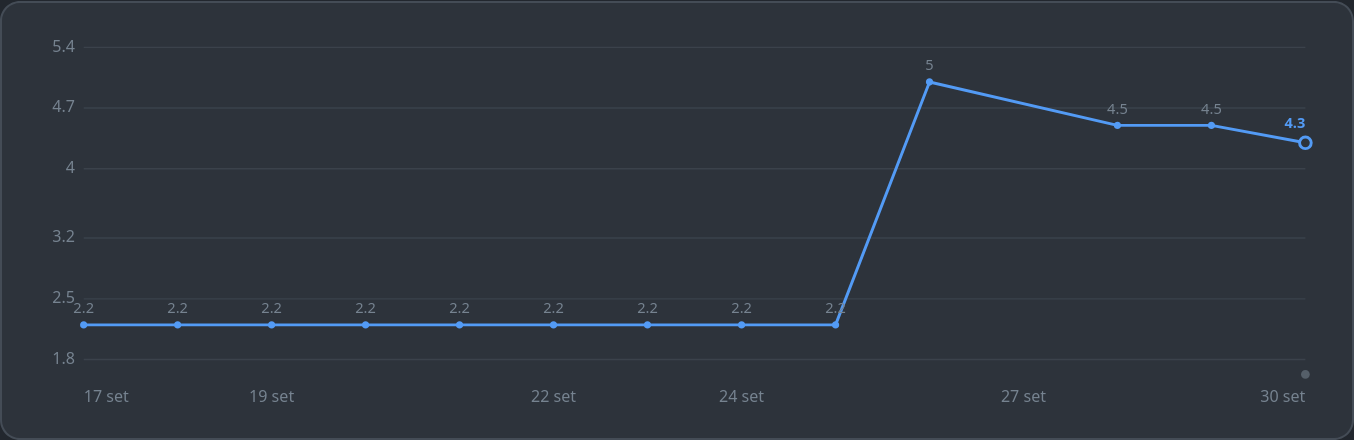
On September 23rd I tried a showcase-post in a subreddit, and gave away ten premium codes.
It got 3,087 views in the first 48 hours, about 3.6k in total. Half of them came in the first four hours; the peak was 654, in the second hour.
The codes were gone almost immediately. I put them in the body of the post, so some of them surely went to bots: wasted. When I saw they had all been used, I updated the post to say so. Requests stopped, which was the right thing, but it also gave people one less reason to comment or DM.
About twenty more people asked for more codes anyway, by DM, by email. Many were profiles whose whole history is requests like that: people who collect apps.
A few people, though, used the app properly. Some of them rely on a screen reader, and they pointed out elements whose labels were missing or not good enough. That's going into the next releases.
 What I'd change: codes only by DM, and where possible in exchange for a first impression of the free version. Asking for a little time in return is a simple way to see who is really interested.
That post gave me some numbers, a few real users and a list of things to do differently, and I'll bring all of it into the next posts.
Talking to those users, I asked a few of them something else: whether Stiva's price matched what an app like this usually costs where they live. Stiva costs €6.99, once, for each major release, and that price is the same everywhere, anchored to Italy. The answers made me look further: some searching online, and a look at a few competitors, several of which set prices by country.
I think €6.99 is right for what this version gives. But converted into the currency of a country with different purchasing power, the link between what you pay and what you get is gone. I haven't changed anything yet.
Agents that only talk through files
The other thing September went into is Atlas.
I added a pipeline for specs. Before a task turns into code, it goes through three roles, each a separate background Claude Code session: a product owner, a UX designer, a developer. They don't talk to each other. Each one writes a file in the task's folder, and the next one reads it. Atlas figures out where a task stands by looking at which files exist and which ones I've approved.
The developer has two modes. On a spike it only studies the task: feasibility, options, risks. Once the analysis is closed, it can write the code.
I've used it on several tasks now. It brings out problems behind a task that I wasn't thinking about. And having the agents read and criticise each other's work made the output better; you can see it in what they write.
If code is wrong, you usually find out quickly: something breaks (not all the time, but it should, somewhere). If a spec is wrong, nothing breaks. You only find out later, when the code built from it does the wrong thing. That's why I approve every step.
It also went wrong in a predictable way. The agents would loop, and every round found a new, more extreme problem. So I changed the rule: a few rounds, then whatever is left at the edges comes to me, and I decide whether it matters or goes.
It's a first version. All that back and forth between agents probably drives token use up, and how the whole thing is managed needs some work in general. There are orchestration systems out there that are far more complete, and well made. I was curious to build one (kind of) inside Atlas, the tool that over time should help me run all my products.
 With all its limits, for now this is human in the loop: nothing moves until I approve it. The goal is to get to human on the loop, where the agents move on their own and I watch, stepping in only when something needs me.
Any thoughts on what I wrote? Reply by email. I read everything.