Templates, metrics and random thoughts on drinklytics' future
Following the learn-by-doing approach, in September 2024 I started working on my first app, Drinklytics. In these articles I share my journey, ideally once a month
Following the “fresh start effect” of the new year, I spent some time reflecting on Drinklytics and its trajectory. I asked myself: what value does Drinklytics actually bring to people?
To answer that, I refined the value proposition:
Drinklytics helps drink enthusiasts build a private, personal archive to remember, compare, and choose the right drink for every occasion.
Three key pillars emerge from this:
- Personal collection
- Retention
- Search & Selection
Consequently, I decided to pivot my North Star Metric (NSM) from:
Drinks added per active user per month
to
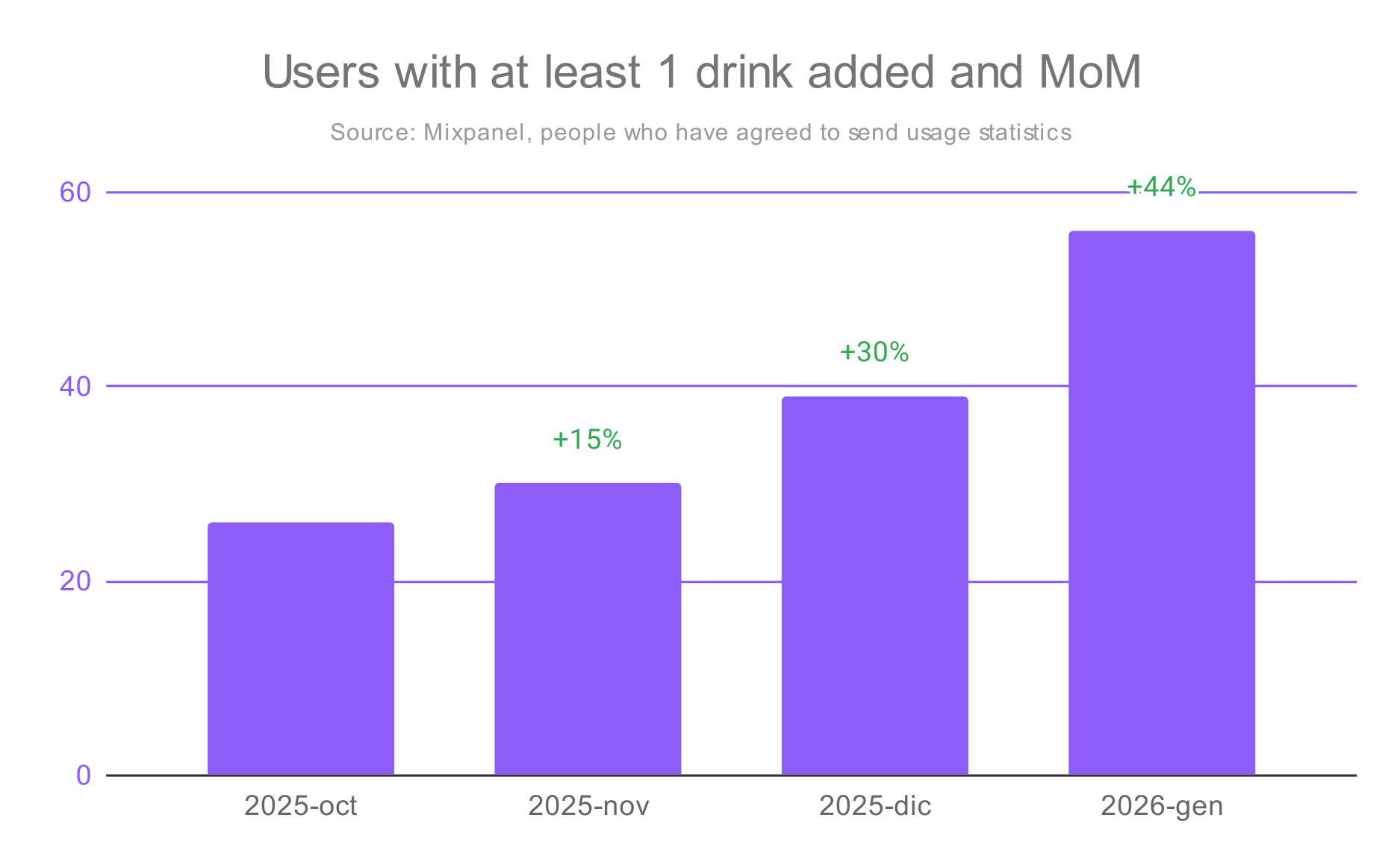
Monthly users who add at least one drink
Here is why this shift makes sense:
- It measures real value: it focuses on consistent engagement rather than raw volume.
- It’s inclusive: it doesn't differentiate between someone who logs a fine wine once a month and someone who logs their daily tea.
- It rewards growth: the metric only grows if the archive stays alive.
The true value lies in supporting a habit. I don’t want to over-engineer the process, but this new NSM aligns much better with my vision. After redefining it, it suddenly became clear how my backlog prioritization was slightly off.
I have now adjusted the I.C.E. parameters of my tasks to align with this new metric.
✅ What’s New
I’ve officially released Drink Templates. Users can now create templates based on drink types, customizing them with specific fields and tags.
To make the process frictionless, as soon as a user selects a drink type, the app automatically loads the corresponding template. This makes logging a new entry significantly faster.
I’m particularly proud of this release because:
- I shipped a feature directly requested by users.
- Feedback came through the “Give me feedback” CTA I implemented in the previous release; it’s great to see users engaging.
- It can directly impact the NSM by lowering the friction of logging a drink.
How Templates work in Drinklytics:
- Flexible Fields: templates can include numeric or text fields. These remain blank when adding a new drink to keep the UI clean.
- Smart Tags: if a user adds a tag to a template, the app asks whether to apply it to old entries or just to the new entries.
- Clean UI: when viewing old entries, empty template fields are hidden. However, if a user hits Edit, those fields appear, ready to be filled.
- Non-restrictive: templates aren't rigid; users can still add custom fields on the fly for specific entries.
- Consistency: I’ve implemented title case formatting for labels to keep the archive looking professional, regardless of the input.
To help those who already have an existing archive, I also developed the Smart Deducer. This tool scans old entries by drink type and automatically suggests templates based on the statistical occurrence of fields and tags. If there aren't enough entries for a precise scan, the Deducer alerts the user, who can still choose to force the template creation.
📈 Numbers and goals
Based on the renewed NSM, here the monthly users which at least add one drink (among those who agreed to send usage statistics):
and here the numbers of active installs with MoM growth rate:
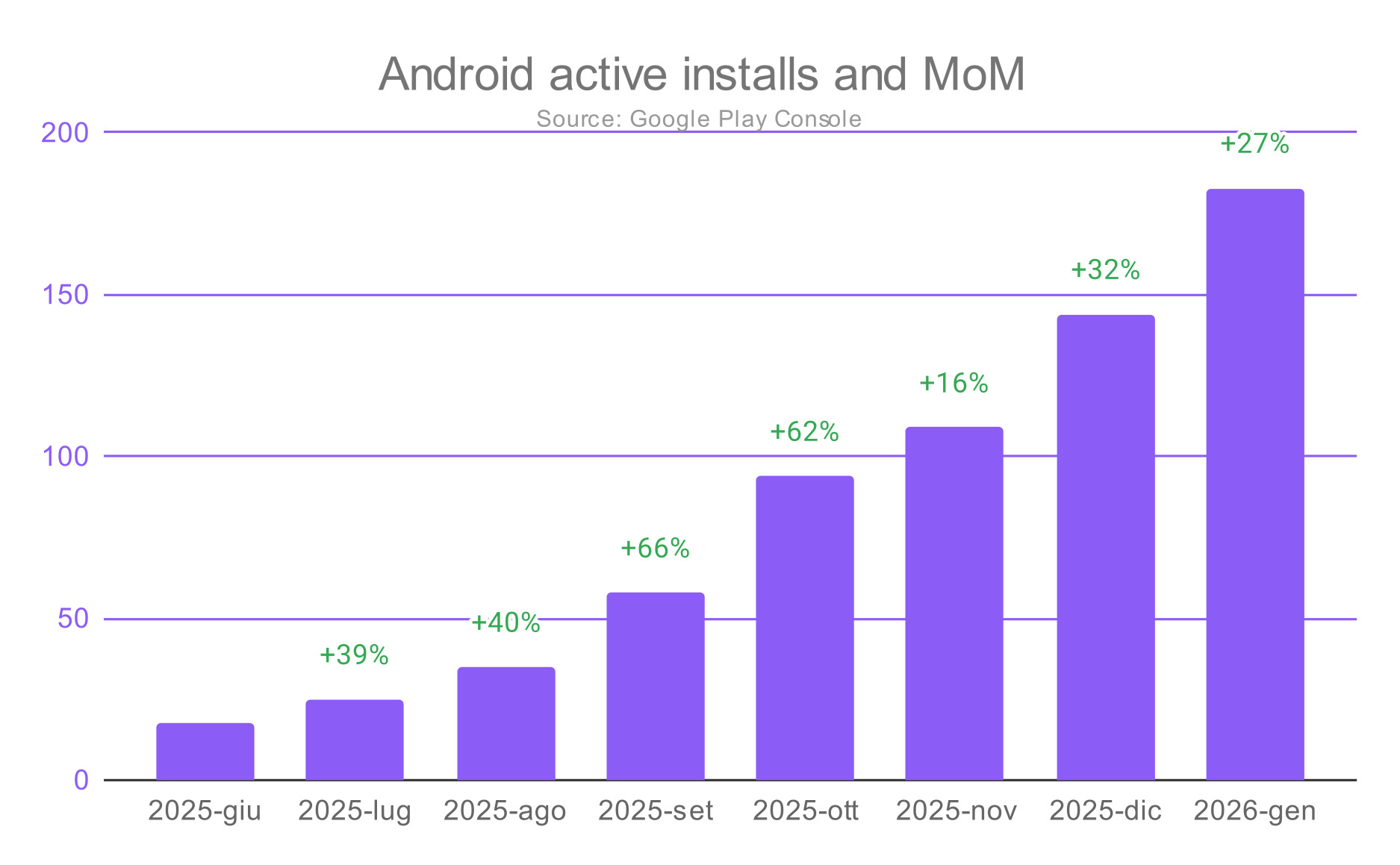
Growth is steady and organic, but slow compared to the potential user base.
At this point in history, when AI enhances, speeds up, facilitates, or unlocks development, reaching potential users becomes the area where we need to focus most of our energy, which is increasingly necessary due to the growth of potential competitors.
Clearly, the product and the experience with the product remain central, but reaching users and doing so quickly makes all the difference.
I think this is particularly true for simple applications that can be replicated in a few hours of work, such as mine.
This could also open up the issue of pricing, with a phenomenon of replication in vibecoding and price reduction that is somewhat reshaping the landscape of this product line, but potentially also larger areas.
Not to mention a future in which app creation will be on-demand and personalized. Perhaps by then Drinklytics will even have 300 active installations.
Drinklytics, personal, offline, tasting notes app
Whether you are a lover or an explorer, create your own personal archive of drinking experiences.


Drinklytics is an Android app for remembering one's drinking. Whether it's beer, wine or hard liquor, with drinklytics you memorize every drink.

Data marketer, product management, python and agile methodologies. This space is my single source of truth.
Here I share #thoughts and #buildinpublic, waiting for the A.I. to conquer the world.
Personal opinions and considerations.